Clocktower Theory: The Trust Spectrum
Personally I find making social plays to be the most satisfying part of playing Clocktower — it feels really cool to pull off a purely social gambit that makes or breaks the game for your team. When you’re on the Evil team I think one thing that can be overlooked is understanding that how much you are trusted can impact your play, so I wanted to dive into that in this post!
Before we continue: a quick disclaimer. Whilst I’ve played a good amount of Clocktower, I don’t consider myself incredibly good at the game and it’s likely other players have their own thoughts on this that might contradict mine. Don’t take my word as gospel, it’s just something that was on my mind that I felt like rambling about today!
To make this easier to talk about, I’m going to divide the Trust Spectrum (a thing I just made up) into five sections: the Five Zones of Trust (another thing I just made up). I’m also mostly only going to approach this from the perspective of playing for Evil, though there’s definitely things that you can take into account when playing for Good here too. Of course the concept of trust is pretty nebulous and can’t be discretely divided in reality, but it’ll help me articulate my points more easily! Broadly speaking, from most to least trusted we’ve got:
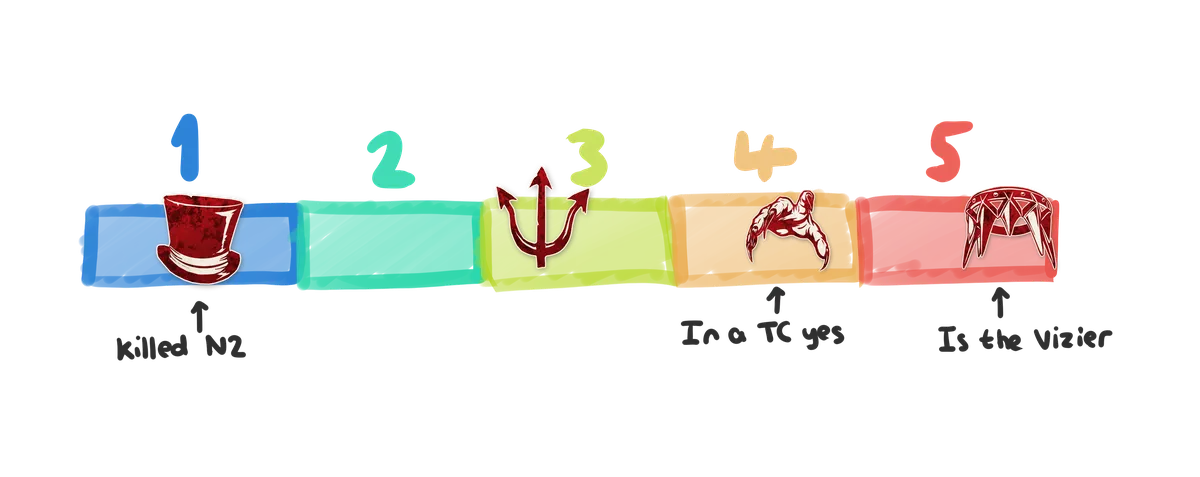
Zone 1: When you’re in this Zone, the Good team are eating out of the palm of your hand. It’s usually pretty hard to get here as an Evil player but it is possible through some clever manoeuvring (and sometimes a little bit of luck). As a recent example, I played a game as the Imp bluffing Fortune Teller. The Poisoner hit the Oracle on Night 2 putting a false Oracle 1 in the town. A Good player was executed on Day 2, and I starpassed with no heat on me Night 3 (and the Oracle number stayed as a 1). Circumstances like this caused me to be extremely trusted by the Good team. If you find yourself in Zone 1 as an Evil player you can play a deep cover strategy — in this case I put a FT no on the new demon, and obfuscated the sober Chef 1 from the start of the game. Note that it’s very hard to stay in Zone 1 if you are alive for a long time — simply not dying is going to cause the Good team to start questioning your alignment, so if you want to play a deep cover strategy, consider getting your demon to kill you early! It can be really effective.
Zone 2: This is where the Good team don’t have reasons (mechanical or social) to distrust you, and are usually willing to give you the benefit of the doubt. You start the game in this Zone and as such what you do here is pretty freeform and depends on how you want to play it. As a Minion, the most straightforward way to play in Zone 2 is to use the fact you’re decently trusted to push away from the Demon, however you also need to be aware that if you move into Zone 3 or 4 later, the Good team may read into who you were pushing on. It’s very important to be aware of when you’re shifting into Zone 3 and change your play accordingly!
Zone 3: This is where the Good team is starting to become distrustful of you, but there’s still a good chance some players will believe you’re on the Good team. Demons often end up in this Zone at the end of the game. If you’re a Minion, ending up here is no bad thing as it can often make you look like a prime Demon candidate in final 3. Depending on how things go you might end up sliding back to Zone 2 or into Zone 4, so be on your toes!
Zone 4: In Zone 4, most players think you are Evil. There is still a lot of value to be gained whilst being in Zone 4 — if you saw your slide down the Trust Spectrum coming and started pushing on your own Demon in Zone 2 and 3, Good players may use that to build a case for keeping your demon alive! Also, whilst players mostly think you’re Evil, sometimes even 10% doubt can cause the Good team to tie themselves in knots, especially if the rest of the information isn’t lining up. Don’t give up, but prepare for the fact your execution is probably coming. If you’re the Demon in Zone 4, it’s time to look for ways out — usually you don’t want to end up in Zone 4 as the Demon unless you’ve got a big voting advantage or an escape hatch!
Zone 5: You are outed Evil. The obvious cases are Vizier and Psychopath, but you can also end up here if you are a Minon claiming to be the Saint who is then executed, for example. When you’re outed Evil nobody is going to trust a word you say but that can be liberating! Bamboozle the Good team with nonsense or try to get them to slip some information to you. Lots of players love being outed Evil, it can be a fun place to play the game from!
And here’s a few random thoughts based on the above:
- Your position on the Trust Spectrum changes throughout the game, and being aware of how it is shifting is crucial. If you have been heavily pushing on your Demon in Zone 2 and end up in Zone 4, it can give your Demon a big layer of cover once people think you’re Evil. On the other hand, if you remain trusted it’s probably going to get your own Demon killed! Keeping up to date with the information and social reads of the town and shifting your play accordingly lets you make huge social plays!
- As an Evil Team, it is generally better for alive Minions to be less trusted than the Demon. There’s nothing worse than being a Minion going into Final 3 with everyone thinking you’re Good and your Demon is most certainly Evil. If you’re getting too trusted as a Minion, then find ways to subtly shift mistrust onto yourself, or get your Demon to kill you and start playing from cover.
- It is easier to move down the Trust Spectrum than up it. If you really wanted to, you could play outed Evil from Day 1! This probably isn’t too effective if the whole Evil team does so immediately though!
- Don’t be predictable. If you always play the same way depending on the Zone you’re in, eventually your group will realize this and read into it, so you can start mixing up your play! Push on your Demon from Zone 2 occasionally if you never normally do so! Pretend you don’t realize you’re untrusted when you’re in Zone 4! Variety will throw off Good players trying to read you!
- To consider as a Storyteller: Games are (usually) most satisfying when the Demon ends up somewhere around Zone 3. Yes, there are games where the information converges and the Demon ends up in Zone 4 and is executed without much fuss, and games where the Demon coasts through in Zone 2 for the whole game. But Zone 3 is where the tensest and most memorable final 3s are made, so crafting your information to achieve this is often desirable.